Why We Slow Pitch Jig: A Short History and Our Own Story on the Northern Gulf
Slow pitch jigging has a strange, almost accidental origin story — and once you understand where it came from, it makes a lot more sense why it works so well on the bottom we fish here out of Pensacola.
Where It Started
The technique traces back to Japanese angler Norihiro Sato. As the story is told, Sato left his rod resting on the boat’s rail with a jig sitting on the bottom in choppy seas — and came back to find a fish on the line. The boat’s own rocking motion, transferred down the line, had been enough to work the jig and trigger a strike. That accident led to intentional design: jigs built asymmetrically, heavier on one side and flatter on the other, so they flutter, glide and fall in a way an angler barely has to work for. Where traditional speed jigging is aggressive — fast reeling, hard cranks — slow pitch is built around subtlety. The jig does the work; the angler reads it and times the pitch.
The technique made its way to American saltwater over the following years, and one of the people most responsible for popularizing it in U.S. waters is Benny Ortiz. Ortiz started out fishing brooks, streams and ponds in upstate New York before moving into offshore fishing, and today fishes out of Florida and the Gulf of Mexico — the same waters we do — in depths from nearshore structure down past 2,000 feet. He’s landed more than 80 different species on slow pitch jigs and has spent years teaching the technique through seminars, in print and online. If you’ve spent any time researching this style of fishing, there’s a good chance his name has already come up.
Why the Northern Gulf Is Built for This
Part of why slow pitch jigging works so well here is the bottom itself. The Northern Gulf off Pensacola isn’t one kind of structure — it’s several, stacked across a broad, gradually sloping continental shelf, and each type calls for a different read.
There’s artificial reef structure, which around here is a real, deliberate program — Escambia County alone has put down dozens of reef sites built from concrete structures in the 45- to 55-foot range not far off Pensacola Pass, specifically designed to vary in size and shape so they mimic natural reef complexity rather than all fishing the same. Then there’s natural live bottom and hard bottom — low-relief rock and limestone outcroppings that were never built by anyone, colonized over time by sponges, soft corals and the small stuff that draws bigger fish in behind them. And further out, the shelf itself keeps giving way to deeper structure, ledges and drop-offs where different species stack up.
That mix matters for jigging specifically. A tight concrete reef holds fish differently than a stretch of scattered live bottom, and how a jig needs to fall, flutter and get worked changes with it. Fishing the same generic presentation over all of it leaves fish on the table. Reading the bottom and picking the right jig for what’s actually down there is most of the game.
How We Got Into It
We came into all of this from bass fishing, where artificials are the only thing you throw — cutting your teeth on bass, you don’t grow up soaking bait. When we got to Florida, offshore fishing meant live bait and cut bait, because that’s what nearly everyone here fishes offshore, so that’s what we did too. At the same time, we kept fishing inshore for trout and redfish exclusively with artificials — that side of our fishing never changed. Some of that inshore habit started bleeding into the offshore side over the years, but even so, we were running something like 80% bait and 20% artificials offshore, maybe throwing a popper or a swimbait here and there.
Eric found slow pitch jigging about four years ago and went all in on it almost immediately — the same way he jumped on fly fishing when he was eight years old. He’s always been like that with a new discipline. He fished it solo for about half a dozen trips before he brought me into it. I wouldn’t call my own reaction reluctant, exactly — it was more practical. We already had a small fortune in tackle built around fishing the way we were fishing. Did we really need to add the expense of an entirely new setup, and would the payoff actually be worth it? It took one trip out to answer that question. The answer was a resounding yes.
We’ve had more than a few charter captain friends and angler friends tell us, more or less, “you need to show me how you’re doing that, because we’re not having the luck you two are having.” For us it was productive almost immediately, and I credit two things for that: our years fishing artificials for bass, speckled trout and redfish, and Eric doing the legwork — every video and article on slow pitch jigging he could find — before either of us ever dropped a jig offshore.
Be clear about one thing: the investment is real. We only buy gear when it’s on sale, and even then it adds up — a good jig alone can run $20. I remember my second trip out, losing five jigs in an afternoon to shark and dolphin depredation — a hundred dollars in tackle gone in a few hours — and finally just putting my rod down and saying I was done for the day. I wasn’t losing any more money to what I was, at that point, fully convinced were a bunch of thieves.
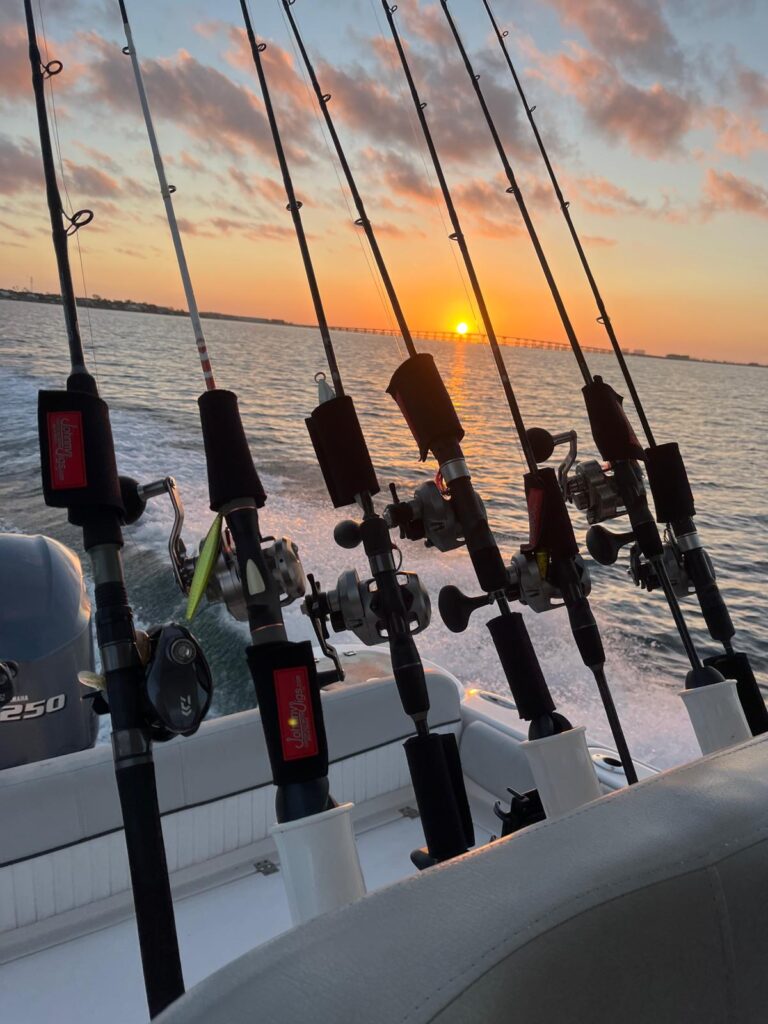
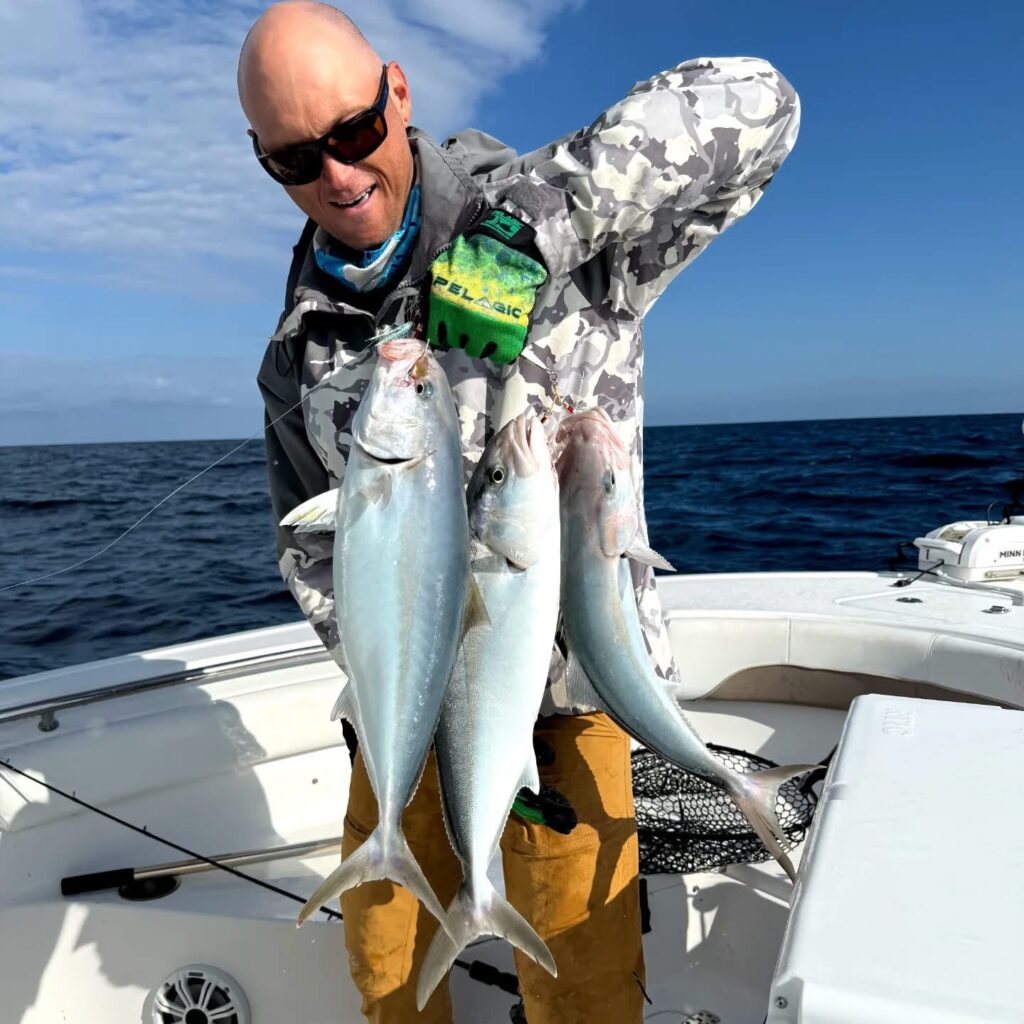
These days, when we’re fishing for ourselves — not running a charter — we don’t touch live or cut bait anymore. We head out with a box of jigs, four rods each rigged and ready, and one more rod apiece set up for swimbaits and poppers when the moment calls for something different. It’s a long way from where we started, and somehow also right back to where we started — fishing artificials, the way we always did before Florida talked us into bait. One last thing, without exception, all of our personal best fish, we’ve caught on the jig.
Depredation Is Real, and It’s Part of Fishing Here Now
That frustration of mine losing five jigs in an afternoon isn’t a one-off story — it hasn’t gone away, and it isn’t unique to us. Anyone who fishes the Gulf regularly has watched a hooked fish get taken apart by a shark or a dolphin before it ever reaches the boat — a bite fish turned to a head, or nothing at all. It’s not a rare or occasional problem; depredation has become one of the most talked-about, and most frustrating, realities of reef fishing in the Gulf, red snapper especially, and it’s drawn real attention from researchers and lawmakers trying to figure out what, if anything, actually helps. There’s no trick that makes it go away — it’s simply part of fishing here now, and something we plan around rather than pretend isn’t happening.
Going Lighter Than the Rulebook Says To
If you look up how to pick a jig weight for slow pitch, you’ll run into the same rule of thumb everywhere: about a gram of jig weight for every foot of water you’re fishing, adjusted up for current. A hundred feet of water, roughly a hundred-gram jig, and so on.
We go the other way. Between the two of us, the question isn’t what the depth calls for by the rulebook — it’s how light we can go and still get the jig to the bottom in a reasonable amount of time. A lighter jig does take longer to fall, that part of the rule of thumb is true. But how it falls — whether it flutters, glides or hunts on the way down — comes from the shape of the jig, not the weight. Weight and action are two different decisions.
In practice, we generally work the bottom first and then work our way up the water column based on what the electronics are showing us. If a jig is taking too long to get down, we’ll step up to something a little heavier. But the starting point is always the same question: how light can I make this work? Not the standard weight for the depth.
Jig Types, Action, and Why the Rod Has to Match
Not all slow pitch jigs move the same way, and picking one isn’t just about weight. A long, pencil-style jig falls straight and fast with a tight flutter — efficient, easy to keep vertical, and usually our first choice. A blunt, torpedo-shaped jig falls a little differently but still stays mostly under control. A flutter jig with a wider profile glides and swims further off the vertical line as it falls — which can trigger fish that won’t commit to something falling straight down, but it also wanders more, which means more tangles when several people are jigging close together. Color plays a role too — gold is almost always where we start.
None of that action means anything if the rod doesn’t match the jig. Slow pitch rods are built to load and unload through the blank on the lift, not just to have backbone for the fight — the taper is what actually transfers your pitch into the jig’s action down at the bottom. A rod that’s too stiff for the jig you’re throwing won’t let the jig do what it’s designed to do, no matter how good your rhythm is; a blank that’s too soft for a heavier jig won’t load properly either. Matching rod action to jig weight and style is as much a part of the technique as the retrieve itself — it’s not a detail you can skip and expect the same results.
Come Fish With Us
Eric brought me into slow pitch jigging, and now we’re excited to bring you into it too — wherever you’re starting from. If you’ve never jigged before but you’re curious, we carry jigging gear on our regular offshore charters, and customers are welcome to pick up a rod and try it alongside everything else we’re doing that day. Spending a 6- or 8-hour charter watching an experienced jigging angler actually work a rod is one of the fastest ways to get a real feel for it — it’ll jumpstart you faster than any video will. If you already jig and just haven’t been putting fish in the boat, we’re happy to talk through what we’re seeing out there and show you the adjustments as we make them. And if you’re already good at this and just need a boat and a spot to fish it from, that’s exactly what our Walk-On Slow Pitch Jigging charters are for.
Come join us aboard the Mermaid One — book a Private charter for your group, or hop on with us for a Walk-On jigging trip if you’re coming solo or don’t have a full group to fill a boat. Either way, it’s an experience you’ll remember. Take a look at all the charter options we offer — Deep Sea/Offshore, Inshore/Nearshore, and especially our Slow Pitch Jigging trips — and find the one that fits what you’re after. We look forward to sharing this experience with you.

To see pictures of some of our catches, visit our social media pages: