Pensacola Slow Pitch Jigging Charters
Serving Pensacola, Gulf Breeze, Pensacola Beach, Navarre, Milton, and the Emerald Coast

Double D Fishing Charters offers federally permitted Pensacola Slow Pitch Jigging charters targeting red snapper, grouper, amberjack, triggerfish, vermilion snapper, and lots of other offshore species. Fish the reefs, wrecks, ledges, and contours of the Northern Gulf with a father-and-son charter team focused on safety, federal deep water access, and an enjoyable day on the water.
Pensacola Slow Pitch Jigging Charters
Our Pensacola Slow Pitch Jigging Charters are dedicated offshore jigging trips for anglers who already understand the basics of slow-pitch jigging and are comfortable fishing independently. Trips run as either as Shared Experience, often called Walk-On, jigging charter, where individual anglers split a fixed charter cost, or a Private charter booked exclusively for your group. We fish vertical jigging with artificial jigs exclusively in Florida State and Federal waters, working reefs, wrecks and natural bottom from roughly 85 to 300 feet. Captain Eric and Captain Paul focus on finding active fish, adjusting depth and location as conditions change, and putting anglers in position to work their jigs. Depending on the day, catches may include Snapper, Grouper, Amberjack, Tilefish, Almaco Jack and plenty of other Gulf species. We do need to make a reservation so we know who and how many are coming to the boat. See “How Our Slow Pitch Charters Work” below for individual angler pricing information.
Why We Slow Pitch Jig
Dad and I came to offshore fishing from backgrounds in bass fishing and fly fishing, where working artificial lures and figuring out what makes fish bite is a big part of the experience. Slow-pitch jigging brought that same active style of fishing to the Gulf, and it quickly became the way we most enjoy fishing offshore.
Instead of dropping bait and waiting, we’re constantly trying to solve the puzzle. We can change jig weight, shape, color, cadence, depth and presentation, or move the boat entirely when the fish aren’t responding. We’re looking for active fish and trying to figure out what they want on that particular day. Sometimes a small change in cadence or jig style makes all the difference. The fish get a vote.
One of the things we enjoy most is that you never really know what’s going to eat the jig. Snapper, grouper, amberjack, tilefish, almaco jack and plenty of other Gulf species will all hit a jig. In our experience, jigging has also produced a very consistent quality of fish while keeping us involved in every drop.
And there is another benefit we don’t mind at all: no squid, no cut bait, and no bait box developing a culture of its own by the end of the day. It’s clean, active fishing that keeps us thinking, adjusting and fishing from the first drop to the last. That’s why we slow-pitch jig.
Slow Pitch Tackle
Slow-pitch tackle is built around the jig. I select the rod based on jig weight. The rod’s primary job is to impart the correct action to the jig; it is not there to overpower the fish. Once a fish is hooked, the reel does most of the work, with the rod used to maintain control while allowing its parabolic action to absorb the fish’s movement.
Because we fish a lot of what would be considered micro jigs, I generally use relatively small terminal tackle and assist hooks rather than oversized hardware. A typical setup uses 2/0 assist hooks, 110-pound swivels and 100-pound #13 split rings. Keeping the terminal tackle appropriately sized helps the jig move the way it was designed to move.
I typically fish 40-pound fluorocarbon leader. My main-line-to-leader connection is either an FG or PB knot, while the leader-to-swivel connection is normally either a chain knot or triple fisherman’s knot.
Line diameter becomes increasingly important as we fish deeper. Thinner braid creates less resistance in the water, reduces line scope and makes it easier to keep the jig underneath the boat. The entire system—rod, reel, braid, leader, terminal tackle and jig—needs to work together, with the rod selected for the jig weight and the reel providing the power when a good fish eats it.
Choosing the Right Jig
I generally want to fish the lightest jig I can get away with while still getting it straight down and maintaining control of the presentation. Depth and current determine how much weight I need, and as we fish deeper I also prefer lighter-diameter line to reduce drag and keep the line from scoping away from the boat.
Color-wise, gold is almost always my first choice, followed closely by gold and green. Most of the jigs I drop have gold somewhere in the pattern. For shape, I usually reach for a long pencil jig or a blunt torpedo-style jig before a flutter jig. They get down efficiently, stay more vertical, and are easier to control around other anglers.
Flutter jigs can be very effective, particularly for snapper, but their wider fall makes them more likely to wander into another angler’s water, tangle lines, or foul. That’s something to consider when several people are jigging close together.
The deeper we’re fishing, the fewer hooks I generally use. A fouled jig at depth means reeling hundreds of feet of line back to the boat without actually fishing, and nobody enjoys winding up 300 or 400 feet because a hook caught the leader or the jig fouled on the drop.
There isn’t one jig that’s right every day. Weight, shape, color, depth, current and the anglers around you all factor into the choice—but if I’m deciding where to start, it’s usually the lightest controlled jig I can fish vertically, and there’s a very good chance it has gold on it.
**How Our Slow Pitch Charters Work
Designed for Individual Anglers & Small Groups
Our scheduled slow-pitch trips give individual anglers and smaller groups an opportunity to fish with others who came for the same reason—to spend the trip slow-pitch jigging. Each scheduled trip has a fixed total charter price, and the participating anglers divide that cost among themselves. The total charter price does not change based on the number of anglers participating.
Pre-Trip Contact & Deposit
Pre-trip contact with Double D Fishing Charters of NW Florida is required. A participation deposit is collected from each angler and applied toward that angler’s share of the fixed charter price.
Cancellations
If an angler cancels at least 36 hours before departure, that angler’s deposit will be refunded. Cancellations made less than 36 hours before departure will result in forfeiture of the deposit.
Changes in the Number of Anglers
Because the charter has a fixed total price, the amount paid by each participating angler may change if someone withdraws from the trip. For example, if four anglers are scheduled and one drops out, the remaining three anglers should be prepared to divide the full charter price among themselves.
If only one or two anglers remain—or if fewer than three anglers ultimately commit to the trip—we will contact the remaining anglers before departure. They will have the option to proceed by dividing the full fixed charter price among themselves or receive a refund of their deposits and the charter will be cancelled.
Once We’re Offshore
These trips are intended for anglers who are comfortable fishing independently. Captains Eric and Paul concentrate on locating productive water, positioning the boat for effective jigging, and moving when necessary to find the next opportunity.
Florida Sales Tax Note: Florida law exempts qualifying crewed fishing charters from sales tax. Florida Department of Revenue guidance distinguishes a fishing charter charged at a fixed rate for the boat or trip, independent of the number of anglers, from a per-person head-boat or party-boat admission. Our scheduled slow-pitch jigging trips are therefore structured as a single fixed-price charter, with participating anglers sharing that fixed charter cost. The total charter price does not change based on the number of anglers participating. See § 212.08(7)(y), Florida Statutes, and Florida Department of Revenue Technical Assistance Advisement 03A-005.
What to Bring
Fishing Gear
Anglers are expected to bring their own slow-pitch rods, jigs, terminal tackle and leader material. We allow a maximum of two personal rods per angler. We may fish from roughly 85 to 300 feet, so bring a selection of jigs appropriate for different depths and current conditions. Electric reels are welcome with an appropriate portable battery that can be secured with your equipment. If you do not have a slow-pitch setup for the trip, please contact us before your charter to discuss equipment availability.
Pack Light
Slow-pitch jiggers typically bring more equipment than anglers on a conventional charter, and with several anglers aboard the boat can become crowded quickly. Please plan ahead and minimize unnecessary carry-on items.
Food, Drinks & Personal Items
Bring a hat, sunglasses, sunscreen, drinks, and a snack or lunch appropriate for the length of your trip. An ice chest is provided aboard for food and drinks, so please do not bring a personal cooler onto the boat. If you arrive with one, you will be asked to transfer your items to the boat cooler and return your cooler to your vehicle.
Alcohol, Smoking & Vaping
Alcohol is not permitted on scheduled/shared slow-pitch jigging charters. Because these trips bring together anglers who may not be part of the same group, one person’s impairment could affect the safety and fishing time of everyone aboard. Smoking is not permitted aboard. Vaping is permitted, although your position on the boat may be adjusted to keep vapor downwind and away from other anglers.
Your Catch
Fish cleaning is not included. Each angler’s catch will be tagged to keep fish identified throughout the trip, and at the end of the charter your fish will be transferred to your personal ice chest at the dock.
Target Species & Fish Handling
Our slow-pitch jigging trips are focused on the species we commonly encounter around reefs, wrecks and natural bottom. Sharks, billfish, barracuda, king mackerel and wahoo are not targeted species on these trips, although any of them can occasionally eat a jig.
If a shark or billfish is hooked and can be successfully and safely brought alongside the boat, we will photograph it when practical and release it.
Our general rule is simple: if a fish is dangerous to bring aboard, or is too large to fit whole in the boat’s fish cooler, it is released back to the sea. This keeps fish handling safe for the anglers and crew while allowing exceptionally large or unexpected catches to be returned to the water.
All directions and decisions of the captain regarding fishing, fish handling, safety, vessel operations, and whether a fish is brought aboard or released are final.
Jig Loss Is Part of Slow Pitch Jigging
Come Prepared
Losing jigs is a normal part of offshore slow-pitch jigging. Jigs may be lost for many reasons, including shark and dolphin depredation, fish break-offs, knot or mainline failure, terminal tackle failure, entanglement with reefs, wrecks or other structure, and tangles with other anglers.
Participants should arrive prepared for this possibility and bring enough jigs and terminal tackle to continue fishing if multiple losses occur. Some trips may result in very few lost jigs, while on other days fish activity, structure and conditions can result in considerably more.
If you have questions or concerns about the amount or type of tackle you should bring, please include that in your conversation with the captains when you call with questions or when arranging your deposit. We would much rather discuss your equipment before the trip than have you arrive unprepared for the conditions we may encounter.
To see photos of some of our catches visit, our social media sites:
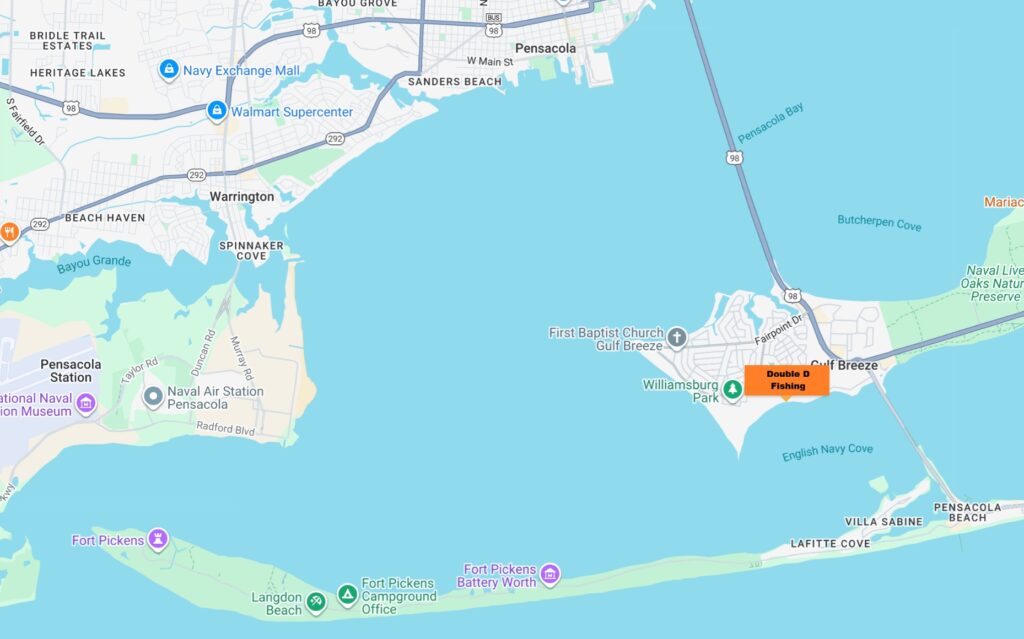
We primarily launch from Shoreline Park in Gulf Breeze but we may choose a different location depending on the season and the area or species we may be targeting. Captains Paul and Eric will coordinate with you where the launch location will be.



